

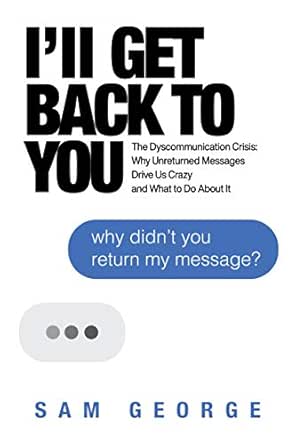
I'll Get Back to You: The Dyscommunication Crisis: Why Unreturned Messages Drive Us Crazy and What to Do About It
by Sam George
About the Book
Digital communication disrupts our relationships with our partners, families, and friends. Uncertainty, anxiety, and misunderstandings are all caused by emails and texts.
I’ll Get Back to You is the first book to teach you how to stop texts and emails from interfering with your relationships and your life.
The issue with emails and texts is that they do not have instant feedback, like direct contact, where you can understand and clarify in real-time. The immediate feedback loop of the past has broken down, leaving us with broken communication loops. It’s created the Dyscommunication Crisis. You never know if the message will be misunderstood or returned.
The worst is an unreturned message. You’ve been texting your boyfriend for over twenty-four hours, and he hasn't responded. You’ve been texting your child all day and haven’t received a response. The result is identical. We conclude something is wrong and justify it using the worst-case scenario.
Unanswered messages have a significant psychological toll. Polls support this:
1. 67% of people suffer from agitation or anxiety.
2. 67% resort to worst-case scenarios to explain.
3. 71% of people fall into negative loops of thinking.
4. 46% admit to making a mistake they regret.
Even when messages are returned, the exchange is not always complete. The message might be vague, or you may misinterpret it, resulting in similar issues. It’s a broken communication loop, and, unlike in the past, there's no direct input to clear things up.
I’ll Get Back to You ensures that they read your message, not just scan it. There are solutions to ensure your messages are fully understood and promptly returned. There are interesting stories about relationships, dating, family, and work, along with self-improvement worksheets. I’ll Get Back to You offers practical solutions:
- Tested tactics so messages are promptly returned.
- Procedures in writing messages so they are understood.
- Strategies to follow up on unreturned messages.
- Proven ways to calm your mind quickly to reduce stress.
There will be no more waiting, worrying, and miscommunication. I’ll Get Back to You has the answers and solutions that will improve your relationships and life.
I’ll Get Back to You is the first book to teach you how to stop texts and emails from interfering with your relationships and your life.
The issue with emails and texts is that they do not have instant feedback, like direct contact, where you can understand and clarify in real-time. The immediate feedback loop of the past has broken down, leaving us with broken communication loops. It’s created the Dyscommunication Crisis. You never know if the message will be misunderstood or returned.
The worst is an unreturned message. You’ve been texting your boyfriend for over twenty-four hours, and he hasn't responded. You’ve been texting your child all day and haven’t received a response. The result is identical. We conclude something is wrong and justify it using the worst-case scenario.
Unanswered messages have a significant psychological toll. Polls support this:
1. 67% of people suffer from agitation or anxiety.
2. 67% resort to worst-case scenarios to explain.
3. 71% of people fall into negative loops of thinking.
4. 46% admit to making a mistake they regret.
Even when messages are returned, the exchange is not always complete. The message might be vague, or you may misinterpret it, resulting in similar issues. It’s a broken communication loop, and, unlike in the past, there's no direct input to clear things up.
I’ll Get Back to You ensures that they read your message, not just scan it. There are solutions to ensure your messages are fully understood and promptly returned. There are interesting stories about relationships, dating, family, and work, along with self-improvement worksheets. I’ll Get Back to You offers practical solutions:
- Tested tactics so messages are promptly returned.
- Procedures in writing messages so they are understood.
- Strategies to follow up on unreturned messages.
- Proven ways to calm your mind quickly to reduce stress.
There will be no more waiting, worrying, and miscommunication. I’ll Get Back to You has the answers and solutions that will improve your relationships and life.
Other Stores

Book Details
| ASIN | B08X668XRP |
|---|---|
| Author(s) | Sam George |